
BGMI Recoil Patterns Explained: Spray Control for Every Meta Weapon
Quick answer: Every BGMI gun’s spray climbs in a predictable shape — learn the shape, drag your thumb the opposite way, and the bullets stay on target. The M416 climbs mostly straight up (easiest to learn), the AKM kicks hard and drifts sideways, and the Beryl M762 is a beast that rewards practice. Ten focused minutes a day in training mode will change your gunfights within two weeks.
Recoil vs Spray Pattern in BGMI: What’s the Real Difference?
Players use these words interchangeably, but they mean slightly different things:
- Recoil is the gun kicking — the physical jump you feel with each shot. It’s the cause.
- Spray pattern is where the bullets actually land when you hold the trigger — the effect. Fire a full mag into a wall without touching your aim, and the bullet holes draw the pattern.
Here’s the key insight: the spray pattern is the same every time for the same gun. It’s not random. That means it’s learnable. A recoil-pattern visualizer is just a tool that draws these shapes for you — pick a weapon and attachments, and it shows you the pattern plus which direction to drag your aim to counter it.
BGMI Meta Weapons: How Each Recoil Pattern Behaves
No fake numbers here — these are qualitative descriptions of how each gun feels and where its spray goes, which is what actually matters when your thumb is on the screen. (Exact numeric recoil values are datamined territory and change with balance patches anyway.)
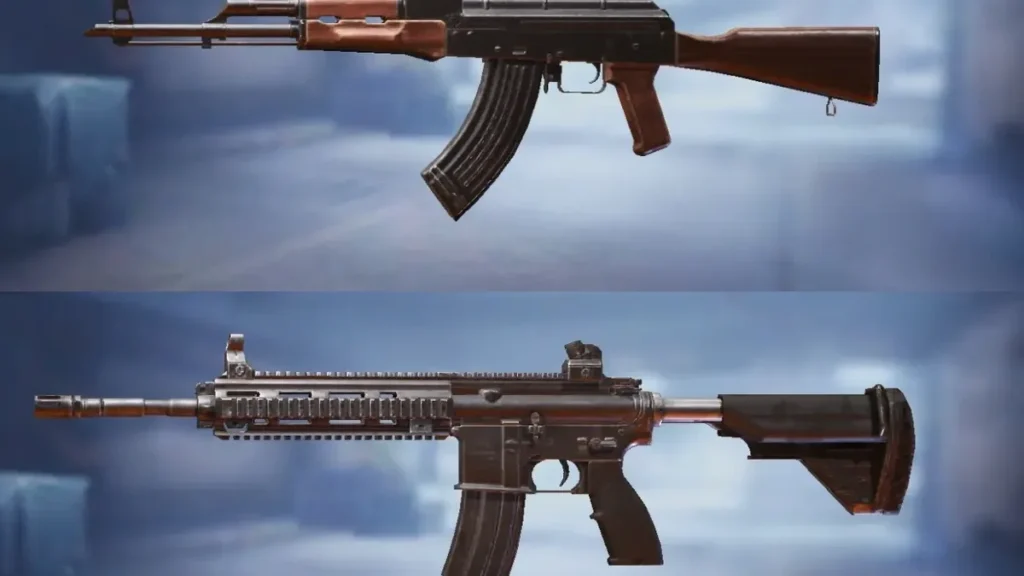
M416 — climbs up, slight drift.
The friendliest spray in the game. The pattern goes mostly straight up with a gentle wobble near the end of the mag. Counter it by dragging steadily down. This is the gun to learn spray control on — if you can’t control an M4, the problem is technique, not the gun.
AKM — hard kick, climbs up and pulls sideways.
The AKM hits like a truck and kicks like one too. The spray climbs fast and drifts to the side, and the first few bullets jump the most. Counter with a firm downward drag plus a slight sideways correction. Best learned in short bursts at first, then full sprays.
M762 / Beryl — violent climb, strong sideways pull.
The fastest-killing AR and the hardest to control. The pattern shoots upward aggressively and yanks sideways midway through the mag. You counter it with a big downward drag and an active sideways correction — this one genuinely needs daily practice. The payoff is enormous in close range.
UMP45 — gentle climb, very controllable.
The UMP is the SMG that behaves like a well-mannered AR. Mild upward climb, minimal sideways movement. Drag down lightly and you’re done. Perfect for players who want a forgiving spray while they build fundamentals.
Scar-L — climbs up, a touch bouncier than the M416.
Very close to the M416 in feel, slightly less stable at the tail end of the mag. If you can spray an M4, you can spray a Scar-L with almost no adjustment.
DP-28 — climbs steadily, slow and predictable.
The DP’s low fire rate makes its pattern easy to read: a steady upward climb with a big magazine to practice on. Great for learning the rhythm of pulling down, though it’s not a gun you’ll spray with in every fight.
Recoil Comparison Table: Difficulty, Attachments and Practice Drills
| Weapon | Recoil difficulty | Best attachments to tame it | Practice drill |
|---|---|---|---|
| M416 | Easy | Compensator + vertical grip + tactical stock | Full-mag sprays at 20m wall, drag straight down |
| Scar-L | Easy | Compensator + vertical grip | Same as M416; compare the two back-to-back |
| UMP45 | Easy | Compensator + vertical grip | Hip-sprays at 10m, then ADS sprays at 15m |
| DP-28 | Medium | Compensator (limited slots) | 10-round bursts at 25m, focus on rhythm |
| AKM | Hard | Compensator + vertical grip | 5-round bursts first, extend to 10, then full mag |
| M762 | Very hard | Compensator + vertical grip | Start at 10m, full mag, big downward drag; move to 20m only when tight |
Attachment notes: a compensator reduces overall recoil the most, a vertical grip specifically calms the upward climb, and a tactical stock (M416) steadies the whole thing. A suppressor hides you but tames recoil less than a compensator — pick based on whether you need stealth or control.
How the BGMI Recoil Visualizer Tool’s Data Model Works
A recoil-pattern visualizer tool is conceptually simple. Here’s the spec:
Inputs:
– Weapon (dropdown: M416, AKM, M762, etc.)
– Attachments (muzzle, grip, stock — checkboxes)
– Distance (short / mid / long)
Processing:
– The tool loads that weapon’s base spray shape, then applies each attachment’s recoil-reduction effect to shrink or smooth the pattern.
– It computes the “control vector” — the direction and amount you need to drag to keep the spray centered.
Outputs:
– A drawn spray-pattern chart (bullet impacts as dots, in firing order)
– A control tip: e.g. “drag down and slightly left for the first 15 rounds, then straight down”
– A difficulty note and a suggested practice drill for that exact setup
The honest limitation: no visualizer replaces muscle memory. The chart teaches your brain the shape; only repetitions teach your thumb.
The 10-Minute Daily Spray-Control Routine
Do this in training mode, every day, before you play matches. Set a timer — ten minutes, no more, no less.
- Minutes 0–2: Warm-up with the M416. Full-mag sprays into a wall at 20 meters. Don’t worry about tightness yet — just get your thumb moving down smoothly.
- Minutes 2–4: Tighten the M416. Same drill, but now try to keep every bullet inside a door-sized area on the wall. Slow the spray down mentally; control beats speed.
- Minutes 4–6: Your main gun. Switch to whichever meta AR you actually use (AKM or M762 for most aggressive players). Bursts first — 5 rounds, then 10 — then full mags.
- Minutes 6–8: Moving target. Spray at the moving targets in training mode. Static walls teach the pattern; moving targets teach you to track while controlling recoil.
- Minutes 8–10: Pressure test. Pick up your loadout, 3x scope, and spray a full mag at 30 meters. If the group is tight, you’re done. If not, that’s tomorrow’s focus.
Rules for the routine: same sensitivity every day (changing sensitivity resets your muscle memory), no skipping the boring M416 warm-up, and stop at ten minutes — fatigue builds bad habits.
Conclusion
Every meta weapon in BGMI has a learnable spray pattern, and ten focused minutes a day will improve your control faster than hours of random TDM. Start with one gun, master its pull-down rhythm, then expand your pool. Recoil control is a trained muscle — build it deliberately.
FAQ
Which BGMI gun has the least recoil?
The UMP45 and M416 are the most forgiving sprays in the meta. The UMP is easiest overall; the M416 is the easiest assault rifle to learn on.
Should I use a compensator or suppressor?
For pure recoil control, the compensator wins. Use a suppressor when staying hidden matters more than having the tightest spray — for example, third-partying a fight.
Does crouching or going prone reduce recoil?
Going prone steadies your weapon noticeably in BGMI; crouching helps a little. Prone spraying is a legitimate technique in open-field fights — just remember you can’t move.
Why can I control recoil in training but not in matches?
Adrenaline and movement. In matches you’re strafing, getting shot, and panicking — all of which wreck fine thumb control. The fix is more match reps, not more wall sprays. Play TDM to bridge the gap.
Do attachments change the spray pattern shape or just shrink it?
Mostly they shrink and smooth the pattern rather than redrawing it. The direction you drag stays roughly the same; you just drag less. That’s why learning the base pattern first matters.
Disclaimer: BuzzGamers is an independent, fan-run website and is not affiliated with or endorsed by Krafton, Inc. or Battlegrounds Mobile India. All game names, marks and images belong to their respective owners.