
TDM to Classic: How to Transfer Your Aim to Ranked Matches (2026 Guide)
TL;DR: TDM aim doesn’t automatically work in classic because the engagement distances, recoil, movement, and decision-making are completely different. The fix isn’t more TDM — it’s 15 minutes of daily training-ground spray drills at 50m/100m, separate sensitivity tuning for classic, and a deliberate first-20-matches plan where you prioritise learning over pushing rank.
Table of Contents
- Why Your TDM Aim Breaks in Classic
- TDM vs Classic: The Real Differences
- Habit Comparison: TDM Player vs Classic Player
- The 5 Transfer Drills That Actually Work
- Sensitivity: Don’t Use the Same Settings
- Loadout Thinking: Stop Looting Like It’s TDM
- Your First 20 Classic Matches: A Simple Plan
- FAQs
Why Your TDM Aim Breaks in Classic
You’ve dropped 25 kills in Warehouse. Your friends call you a TDM god. Then you queue one classic match, land in Pochinki, and get beamed by some random player you never even saw. Sound familiar?
Here’s the uncomfortable truth: being cracked in TDM and being good in classic are two different skills. TDM trains your close-range reaction and tracking. Classic needs that plus distance control, recoil management, game sense, and the patience to not peek everything that moves.
I see this mistake every season. Players grind 300 TDM matches thinking they’re “practicing,” then blame teammates when their classic KD is 1.2. TDM isn’t useless — it’s genuinely the best place to build raw reaction speed. But if you don’t deliberately transfer those skills to classic, you’ll stay a lobby legend who dies in the top 40.
Let’s break down exactly what’s different, and how to bridge the gap.
TDM vs Classic: The Real Differences
1. Engagement distance
In Warehouse, 90% of your fights happen within 15 metres. Your brain learns to hip-fire, jump-shot, and laser with an SMG or AKM at point-blank range. In classic Erangel, most real fights happen at 40–100 metres — often across open fields or compound compounds where your hip-fire aim is useless.
A TDM player tries to run at everyone like it’s Warehouse. A classic player knows when a fight is winnable and when to reposition. Distance judgment is a skill, not a setting.
2. Recoil control vs “lasering”
In TDM, you pick up a pre-loaded gun, respawn in 5 seconds if you die, and spray without thinking. Many TDM mains develop a habit of holding the trigger and hoping the tracking carries them. In classic, you can’t afford that — a 30-bullet miss in a real match means a third party rolls up on your position while you’re reloading with no cover.
Classic spraying needs controlled bursts and actual recoil control for 4x/6x scopes. TDM rarely teaches you 6x control because nobody uses 6x in Warehouse.
3. Movement and peeking
TDM movement is chaotic: jump-peeking, sliding around crates, constant repositioning with zero punishment for mistakes because you respawn instantly. Classic punishes every bad peek with a one-way trip to the lobby. In classic you need to learn pre-aiming angles, jiggle peeking to gather info, and shoulder-swapping around cover — none of which Warehouse teaches you.
4. Sound discipline
This is the silent killer. In TDM, nobody cares about footsteps — everyone knows where everyone is. TDM players develop a habit of sprinting everywhere, jumping off everything, and firing unsuppressed guns with zero thought. In classic, that behaviour hands your position to every squad within 100 metres. Your aim can be perfect and it won’t matter if the enemy hears you rotating first and pre-aims your head.
5. Decision-making under stakes
In TDM, dying costs you 5 seconds. In classic, dying costs you 20 minutes of looting and rotating. That changes everything: when to take a fight, when to disengage, when to third-party. TDM teaches you to take every fight. Classic teaches you to take the right fights. That mental switch is the hardest part of the transfer, and no amount of Warehouse grinding builds it.
Habit Comparison: TDM Player vs Classic Player
| Habit | TDM Player (default) | Classic Player (what you need) |
|---|---|---|
| Fight range | Runs at every fight, 10–15m | Judges distance, fights at 30–80m mostly |
| Spraying | Full-auto hold, no burst control | 5–8 bullet bursts at range, full spray only close |
| Recoil | Controls up to red dot/3x | Controls 4x/6x with gyro pull-down |
| Peeking | Jump-peeks everything | Jiggle-peek for info, pre-aims known angles |
| Movement | Sprint + jump everywhere | Crouch-walks near compounds, uses cover |
| Sound | No discipline, fires freely | Suppressors, listens before rotating |
| Dying | “Koi baat nahi, respawn” | Treats every death as a lesson — reviews what went wrong |
| Looting | Picks whatever spawns | Plans loadout: AR + DMR/sniper, proper attachments |
The 5 Transfer Drills That Actually Work
These are training-ground drills. Do them for 15 minutes before your classic session, not instead of it.
Drill 1: The 50-metre spray wall
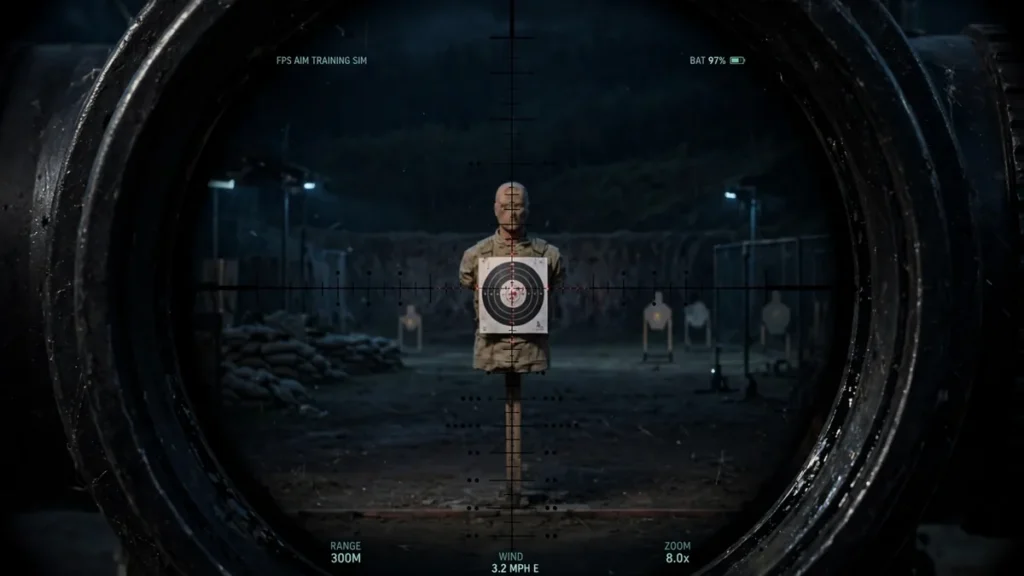
Go to the training ground, pick an M416 with a 3x scope, stand 50 metres from a wall, and spray full mags while pulling down. Your goal: keep 80% of bullets in a tight cluster. Do 10 mags. This is the single most important drill for a TDM player because it builds the one thing Warehouse never teaches — sustained recoil control at real fight distances.
Drill 2: The 100-metre burst drill
Same setup, but at 100 metres with a 4x or 6x. Fire in 5–8 bullet bursts. Watch where the first 5 bullets land — that’s your real accuracy window. Most classic fights are decided in the first burst. If your first 5 bullets aren’t grouping, your long-range fights are coin flips.
Drill 3: Moving target tracking
Use the moving targets in the training ground. Track them with an SMG (UMP45) at 20–30 metres — this is where your TDM skill actually transfers. Then switch to an AR at 50 metres. The point is to connect your close-range tracking to mid-range tracking with the same hand.
Drill 4: Peek-and-shoot reps
Find a wall or crate in the training ground. Practice jiggle-peeking: quick left-right leans, firing 3–4 bullets each peek. TDM players peek by jumping into the open; classic players peek to gather information and chip damage. Do 5 minutes of this — it rewires the jump-peek instinct.
Drill 5: Hot-drop simulation (the real test)
Queue classic, but drop hot every single match for 10 matches straight — Pochinki, Georgopol, Military Base. Not to win: to practice. Hot drops are the closest classic gets to TDM chaos, and they’re where your Warehouse reactions genuinely help. Your goal isn’t placement, it’s winning 2–3 close-range fights per drop, then rotating out and playing the rest of the match properly. This drill builds the bridge between the two modes.
Sensitivity Settings: Don’t Use TDM Settings in Classic BGMI
Here’s a mistake almost every TDM main makes: using their Warehouse sensitivity in classic. TDM rewards twitchy, high sensitivity because everything is close. Classic needs stability at range — a 6x spray with shaky hands is just noise.
You don’t need my exact numbers (every phone and hand is different), but the principle is this: your classic sensitivity should be slightly lower than your TDM sensitivity, especially for 4x/6x scopes and gyro. Many players keep two sensitivity presets — one tuned for TDM, one for classic — and switch between them. BGMI lets you save different setups, so use that.
Test it this way: if you can 180-flick in TDM easily but your 4x spray at 80 metres wobbles all over the place in classic, your sensitivity is too high for ranked. Lower the scope sensitivities gradually until your sprays group, then leave it alone for at least a week. Constantly tweaking settings is how players stay bad forever.
Loadout Thinking: Stop Looting Like It’s TDM
In TDM, your gun is given to you. In classic, your loadout is a decision — and TDM players loot like they’re in a hurry to get back to fighting. Slow down.
The classic meta loadout for a transferred TDM player: one close-range weapon you’re already good with (UMP45, AKM, or M416) plus one ranged weapon (Mini14, SKS, or a bolt-action if you can handle it). Your TDM skills cover the close-range slot. Your training-ground drills cover the ranged slot.
Attachments matter more than you think. A vertical grip + compensator + tactical stock on your M416 is the difference between a controllable spray and a sky-beam. In TDM you never think about this. In classic, a fully-kitted gun vs a naked gun is a different weapon entirely. Prioritise attachments over a third gun you’ll never use.
And please — stop skipping the 4x scope because “red dot feels better.” Red dot feels better because it’s your TDM habit talking. Force the 4x for a week. Your future self will thank you.
Your First 20 Classic Matches: A Simple Plan
Don’t try to push rank immediately. Treat your first 20 matches as a training block with specific goals:
Matches 1–5: Drop hot, die a lot, learn.
Drop Pochinki or Georgopol every time. Focus only on winning close-range fights. Don’t worry about placement or minus. You’re calibrating your TDM skills to real opponents with real stakes.
Matches 6–10: Add rotations.
Same hot drops, but now after winning your fights, practice rotating to zone early instead of hunting kills. Learn the timing: when to leave, which compounds are safe, how to cross open ground with smoke. This is where classic game sense starts forming.
Matches 11–15: Play for placement.
Drop slightly safer, play edge-of-zone, take only fights you can win quickly. Aim for top 10 every match. Notice how different the pacing feels — this is classic. Your KD might dip; that’s fine, your average placement should climb.
Matches 16–20: Combine everything.
Now play to win. Hot drop when the flight path allows, rotate smart, third-party like a professional. By match 20, you’ll feel the transfer happening — your TDM reactions firing in close fights, your drills holding up at range.
After 20 matches, review: where are you dying? If it’s still close-range fights, you need more TDM-style reaction work. If it’s mid-range beams, back to the training ground. If it’s rotations and zone, that’s game sense — it only comes with matches, so keep playing.
Conclusion
TDM aim doesn’t automatically transfer to Classic BGMI matches — the pacing, positioning, and looting are completely different games. Run the 5 transfer drills, fix your sensitivity for Classic, and give yourself 20 matches to adapt.
FAQs
Q1. Should I stop playing TDM completely when moving to classic?
No. Keep TDM as your warm-up — 2–3 matches before classic to wake up your reactions. Just stop treating it as your main practice. The training ground and real classic matches are where the transfer happens.
Q2. How long does it take to transfer TDM aim to classic?
Honestly? 3–4 weeks of deliberate practice for most players. You’ll feel close-range confidence within days, but mid-range control and game sense take longer. Anyone promising “7-day transfer” is selling you something.
Q3. Is gyro necessary for classic?
Not strictly, but it makes 4x/6x spray control dramatically easier, and almost every serious classic player uses it. If you’re coming from TDM without gyro, start with low gyro sensitivity on scopes only, and give it two weeks before judging.
Q4. My KD dropped from 4 in TDM to 1.5 in classic. Am I bad?
No — that’s completely normal. TDM KD and classic KD measure different things. A 2.0+ KD in classic with good average placement is genuinely strong. Stop comparing the numbers across modes.
Q5. What’s the biggest mistake TDM players make in classic?
Taking every fight. In TDM that instinct wins matches; in classic it gets you third-partied in the top 30. Learning to disengage from a bad fight is the single highest-value skill you can build.
Q6. Should I use separate sensitivity for TDM and classic?
Yes, ideally. Keep your twitchy TDM setup for Warehouse, and tune a slightly steadier setup for classic — especially scope and gyro sensitivities. Switch between the saved presets instead of constantly adjusting one setup.
Disclaimer: BuzzGamers is an independent, fan-run website and is not affiliated with or endorsed by Krafton, Inc. or Battlegrounds Mobile India. All game names, marks and images belong to their respective owners.